

Practical Dog Grooming Training That Gets You Working
05 Sep 2026
A dog does not care whether you have spent years in an office, worked on a production line or raised a family. It cares whether you can handle it calmly, groom it safely and return it looking and feeling its best. That is why practical dog grooming training matters so much for people who want a genuine route into self-employment. You need more than a certificate. You need the confidence to work with real dogs, real coats and real customers.
For an aspiring mobile groomer, training is not simply the first box to tick. It is the point where a love of dogs becomes a service people will pay for. The right training gets you ready to produce quality work, manage your day and begin building a business without months of uncertainty.
What practical dog grooming training should teach you
Good grooming cannot be learned properly by watching a few videos or practising only on one cooperative pet. Every dog is different. A nervous rescue, a large double-coated breed, a wriggly puppy and an elderly dog all require a different approach. Your hands, eyes and judgement improve through supervised work with a variety of dogs.
Practical training should put the emphasis on safe handling from the start. That means learning how to read a dog's body language, introduce the grooming process without rushing, use restraints correctly and recognise when a dog needs a pause. A smart groomer does not force a dog through an appointment. They work with patience, control and clear routines.
You should also learn the full working sequence rather than isolated techniques. Bathing, drying, brushing, de-shedding, clipping, scissoring, nail trimming, ear care and finishing are connected. If a coat has not been washed and dried correctly, the final clip will show it. If you do not understand coat condition, you can make a poor decision before the clippers even come out.
The aim is not to make every dog look like a show-ring champion. Most owners want their dog clean, comfortable, tidy and handled kindly. Achieving that consistently is what creates repeat custom.
Why hands-on experience beats theory alone
Theory has a place. You need to understand canine skin, coat types, hygiene, parasite awareness, tools and basic welfare. But theory cannot teach the feel of a matted coat, the speed at which a wet spaniel can shake water across a van, or the calm voice needed when a nervous dog hears a dryer for the first time.
Hands-on sessions let you make decisions while an experienced trainer is beside you. You can ask why a blade has been chosen, how much coat can be safely removed or what to do when a dog will not stand still. That immediate feedback saves time and prevents bad habits becoming routine.
This is especially valuable if you have no previous grooming background. You do not need to arrive as an expert. You do need to be willing to listen, practise and improve. A focused training programme can move a motivated beginner forward quickly because it concentrates on the work they will actually carry out each day.
There is a trade-off. Fast-track training is intensive. It demands concentration, physical effort and a willingness to get involved rather than stand at the side. For someone ready to change direction and start earning, that intensity is often a strength. You are building practical capability with a clear purpose.
Training for the reality of a mobile grooming business
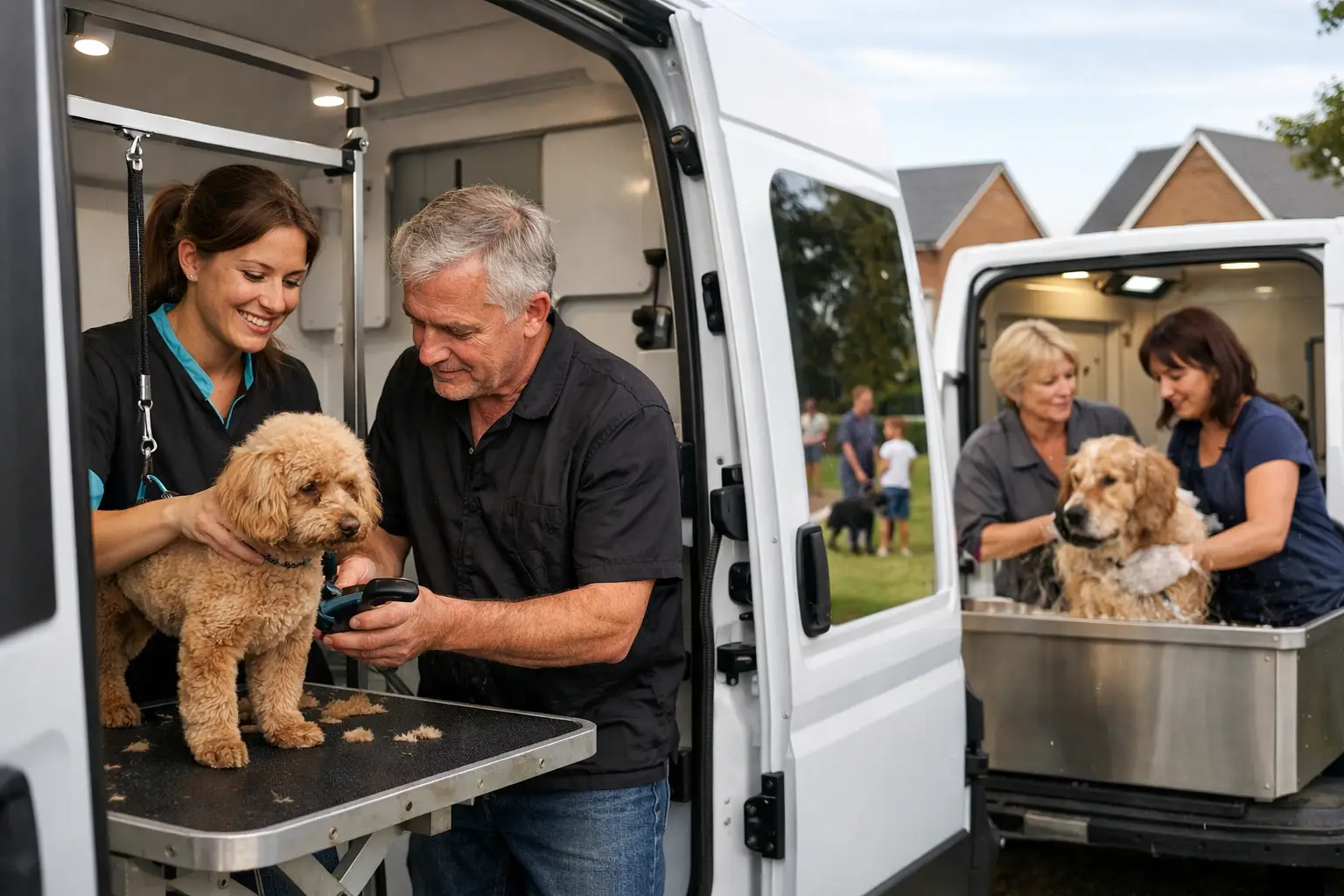
A mobile grooming service has advantages that a salon cannot always match. You travel to customers, work from a purpose-built space and avoid the cost and commitment of renting commercial premises. But the van also needs to function as your workplace, your customer-facing environment and your daily operation.
That is why grooming skills alone are not enough. A useful programme teaches you how to prepare equipment, maintain cleanliness between appointments, manage water and power, keep tools in safe working order and organise a sensible schedule. A late first appointment can affect every customer after it, so efficient routines matter.
You also need to learn how to communicate professionally. Owners may be concerned about matting, skin irritation, behaviour or the length of coat being removed. Clear, honest conversations protect the dog and set the right expectation. A groomer who explains the process calmly will earn more trust than one who promises an unrealistic result.
In Ireland and Northern Ireland, a mobile service can offer a particularly attractive business model for customers with busy lives, limited transport or dogs that find a busy salon stressful. Convenience brings enquiries, but quality is what turns those enquiries into loyal regulars.
The business skills that make training pay off
Many talented groomers struggle because nobody has shown them how to run a business. They may do excellent work but underprice appointments, leave gaps in the diary or hope that customers will somehow appear. Training for self-employment needs to tackle those issues directly.
You should understand how to price according to breed, coat condition, time and the work involved. A severely matted dog is not the same booking as a well-maintained dog of the same breed. Charging fairly is not about being expensive. It is about making sure the business can sustain your time, equipment, fuel, products and income.
Marketing also needs to be practical. You need to know how to present the service clearly, turn enquiries into bookings and encourage customers to rebook before their dog's coat becomes unmanageable. A regular six- or eight-week grooming cycle is better for the dog and far better for building predictable revenue.
This is where a franchise route can remove much of the guesswork. Dial a Dog Wash Ireland combines one-to-one practical training with a fully converted van, marketing instruction and ongoing operational support. Instead of trying to build a brand, choose equipment and create every process from scratch, franchisees can focus on developing their skill and serving customers when they put it into practice
What to look for before committing to a course
Do not choose training based on a glossy promise or the cheapest price. Ask what you will actually do during the course. Will you work on live dogs under supervision? Will you learn to use professional equipment? Will the trainer correct your technique and explain the reason behind each decision?
It is also worth asking whether the programme reflects the work you want to do. If your aim is to operate a mobile grooming business, training inside a real working setup is far more relevant and purposefull for an aspiring entrepreneur than a course built entirely around classroom demonstrations. You should leave with a realistic understanding of appointment flow, cleaning, customer handovers and the physical nature of the job.
Look for support after initial training as well. Nobody becomes fully polished in a few days, because experience continues to teach you. What matters is having a strong foundation and someone knowledgeable to turn to when you meet an unfamiliar coat, difficult behaviour, difficult day or any other business challenge. Good back up after initial training can be priceless for a quicker development.
Confidence comes from doing the work
Career changers often ask whether they are too old, too inexperienced or not naturally confident enough to start. The better question is whether they are prepared to learn a hands-on skill and follow a proven process. Plenty of successful business owners began with no grooming experience at all. Their progress came from training, repetition and the decision to take themselves seriously.
Dog grooming is demanding work. You will be on your feet, you will deal with muddy paws and you will occasionally meet a dog determined to test your patience. Yet it can also give you something a standard job rarely does: visible results, grateful customers and control over the business you are building.
Choose practical dog grooming training that prepares you for the dogs in the real world of grooming, the customers and the daily running of the service. Then put the learning into action. Every well-groomed dog that leaves happy is not just a job completed. It is proof that your new business is becoming real.