

Is a Mobile Dog Grooming Van Franchise Good in Rural Areas?
25 Aug 2026
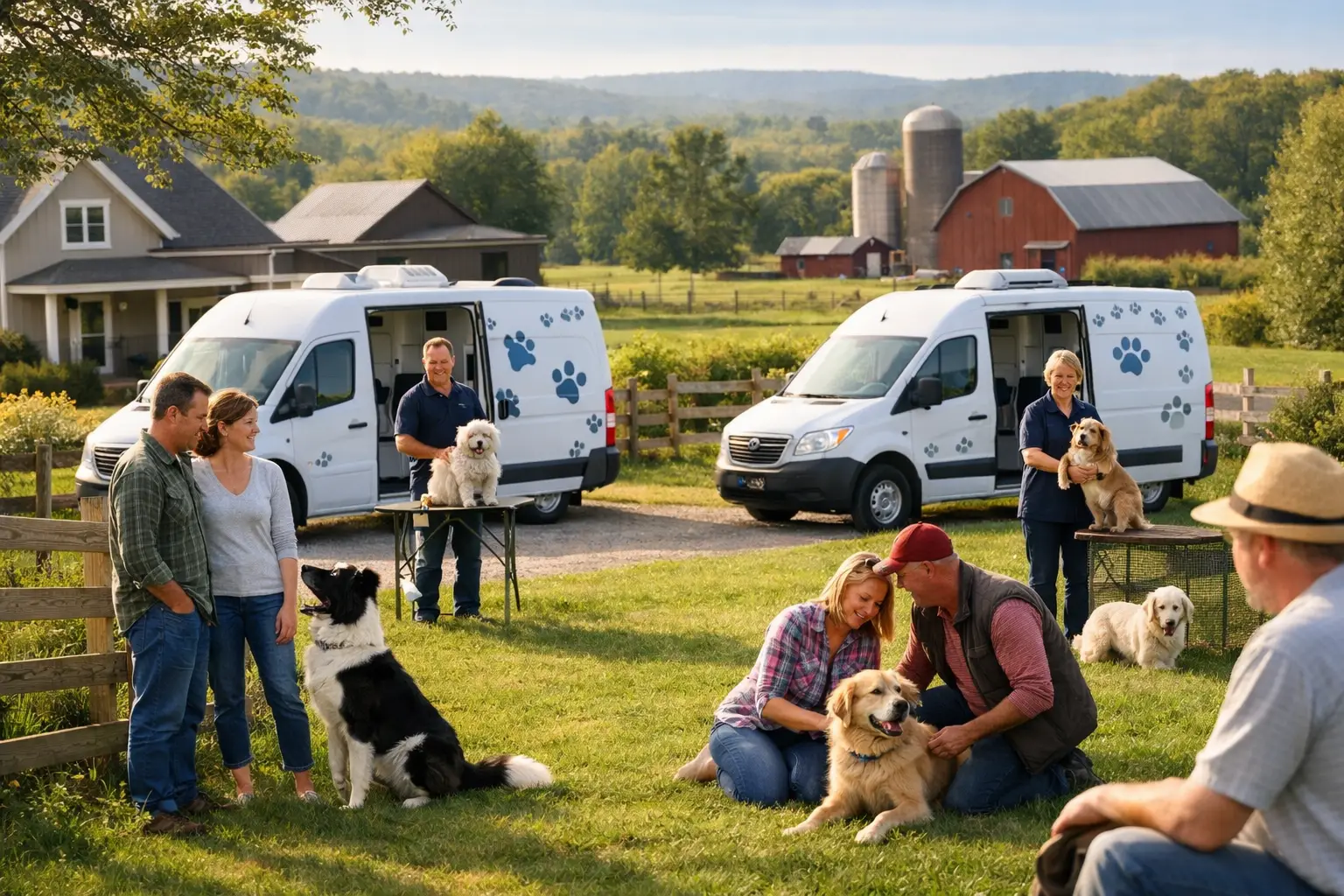
A town does not need a high street packed with salons for a dog grooming business to work. In fact, the question, “is a mobile dog grooming van based franchise good for rural locations as well as cities?”, often has a more encouraging answer in rural areas than people expect. Where owners are used to driving 20, 30 or even 40 minutes for everyday services, a professional groomer arriving at their door is a serious convenience.
The important point is this: rural success does not come from copying a city route. It comes from building the right territory, planning appointments intelligently and giving local dog owners a service they genuinely struggle to find elsewhere.
Is a mobile dog grooming van franchise good for rural locations?
Yes, it can be an excellent fit, provided the territory has enough dog-owning households and you operate it with discipline. A mobile grooming van removes one of the biggest barriers facing a rural customer: travelling to a salon, waiting around, then making the same journey again to collect their dog.
For older customers, busy families, farmers, people with limited transport and owners of anxious or elderly dogs, doorstep grooming is not a luxury. It is a practical solution. The convenience is also valuable in towns and villages where the nearest established groomer may already have a long waiting list.
A franchise model can be especially useful for someone entering the industry without previous grooming or business experience. You are not trying to work out training, van conversion, pricing, local marketing and daily systems alone. You start with a vehicle designed for the job, practical skills training and a framework for turning enquiries into regular bookings.
That does not mean every rural eircode or postcode will produce the same results. A scattered area with very few households and long distances between appointments needs careful assessment. The opportunity is strong when there is a sensible mix of villages, market towns, commuter areas and surrounding countryside within a manageable drive.
Why rural customers value the mobile model
City customers often choose mobile grooming because their schedule is busy. Rural customers may choose it because the alternative is inconvenient, time-consuming or simply unavailable. That distinction matters when you are building repeat custom.
A well-groomed dog is not a one-off purchase. Most breeds need regular maintenance, whether that is a full groom every six to eight weeks, a wash and dry, nail clipping, deshedding or coat care between major appointments. Once a customer sees the benefit of a reliable groomer coming to them, regular scheduling becomes much easier.
Rural communities can also be powerful referral networks. A good result on one dog can lead to conversations at the school gate, the local shop, the walking trail or the village Facebook group. Trust travels quickly in close-knit areas. So does poor service, which is why punctuality, presentation and consistent grooming standards are non-negotiable.
There is another advantage: you do not have to pay for a salon on a high street. A purpose-built mobile van lets you bring the salon to the customer while operating within an exclusive area. That can keep the business focused on earning from appointments rather than carrying the overheads of commercial premises.
The trade-off: distance must be managed properly
The biggest challenge in rural grooming is not demand. It is dead mileage. If you spend too much of the day driving from one isolated booking to another, fuel costs rise, tiredness increases and the number of dogs you can groom falls.
The answer is route planning, not hoping every day will fall into place. Book nearby customers on the same day. Build designated village days. Encourage repeat clients to pre-book their next appointment before you leave. Where appropriate, use a small travel charge for appointments well outside your core route.
A strong rural operator thinks in clusters. One Tuesday might be focused on a particular town and its surrounding estates. Thursday may be reserved for another group of villages. Over time, customers learn your schedule and often accommodate it because the service saves them a journey of their own.
You also need to be realistic about what you can deliver in a day. It is better to run a full, profitable route in a defined area than to chase every enquiry across a huge county. Territorial exclusivity gives you room to build locally, but it does not mean you should cover every mile of it every day.
Cities offer density, but they bring different pressure
Cities can deliver more homes, more dogs and shorter distances between appointments. That density can make it easier to fill a day, especially in areas with large numbers of professionals, families and flat developments. Customers may have less time, limited parking or no interest in transporting a wet dog home after a salon visit.
However, urban areas can also bring heavier traffic, parking restrictions and more direct competition from salons, home groomers and other mobile operators. A city route can look compact on a map but lose time quickly if access is awkward or parking is impossible near the property.
Rural areas generally have the opposite profile: less competition and easier parking, but more travelling between bookings. Neither is automatically better. The better territory is the one where customer demand, route density and your working preferences line up.
If you enjoy knowing your local community, building a loyal customer base and working across villages and small towns, rural territory may suit you brilliantly. If you prefer faster-paced days with closer appointments and a larger volume of enquiries, a city or suburban territory may be more appealing.
What to assess before choosing a territory
Do not judge an area solely by population. Look at the type of households in it. A territory with family homes, active dog-walking communities, established villages and people who value convenience can be more attractive than a more populated area with limited disposable income or excessive competition.
Ask practical questions. Are there existing groomers nearby, and are they booked up? How far do residents currently travel for grooming? Are there several villages that can be grouped into a sensible weekly route? Is the area home to commuters who are willing to pay for convenience? Can you park safely outside most customer properties?
Also consider your own base. Starting from a location near the centre of your territory can dramatically improve daily efficiency. If your first appointment is 45 minutes away every morning, that time has to be accounted for. A business is built on the hours you can charge for, not the hours you spend behind the wheel.
A franchise gives rural operators a faster starting point
Starting independently may sound straightforward until you add up what is required: grooming competence, a compliant and professionally equipped vehicle, customer policies, insurance, pricing, booking processes, advertising and the confidence to sell your service. For many career changers, those early decisions are where costly mistakes happen.
With Dial a Dog Wash Ireland, franchisees receive intensive practical training, a fully converted grooming van and ongoing business support designed to get them trading quickly. That matters in a rural setting, where your reputation needs to be established fast and every early customer can become a source of repeat bookings and referrals.
The training is not only about producing a tidy groom. It is about handling dogs safely, managing appointments, communicating professionally with owners and running a business that customers trust. Those skills matter whether you are parked outside a city home or a farmhouse at the end of a country lane.
The strongest rural businesses are built on repeat appointments
A rural mobile grooming franchise should not rely on constantly finding new customers. New enquiries are valuable, but the real stability comes from turning satisfied owners into regular clients. Pre-booking is one of the simplest ways to protect your diary and reduce the pressure of marketing every empty slot.
Give customers a reliable routine. Arrive when you say you will. Explain the service clearly. Treat each dog with patience. Keep the van clean and professional. When the dog comes back looking and feeling great, ask for the next booking while the value of the visit is fresh in the owner’s mind.
That approach turns a broad rural territory into a dependable round of profitable route days. It also gives you more control over your working week, which is one of the main reasons people leave traditional employment to become self-employed in the first place.
A rural location is not a second-best choice to a city. For the right person, it can be the smarter one: lower local competition, loyal customers, easier access and a service people are genuinely grateful to have. Choose the territory carefully, run your route tightly and build your reputation one well-groomed dog at a time.