


How to Price Mobile Grooming for Real Profit
17 Sep 2026
A mobile grooming van can be busy from morning to evening and still leave its owner short of money at the end of the month. That usually is not a demand problem. It is a pricing problem. Learning how to price mobile grooming means charging for the real work involved: your grooming skill, your time, the van, the journey, the products, and the convenience you bring to a customer's door.
For someone moving into self-employment, getting prices right early matters. Charge too little and you create a diary full of difficult appointments that do not pay a proper wage. Charge too much without explaining the value and you may struggle to build momentum. The answer is not to copy the cheapest local salon. It is to build prices around a profitable mobile service.
How to price mobile grooming without guessing
Start by recognising that mobile grooming is not salon grooming on wheels. A customer is paying for a professional groomer to arrive at their home in a purpose-built workspace, at an agreed time, without them needing to load a muddy or anxious dog into the car, wait around town, or rearrange their day.
That convenience has value. So does the fact that each appointment involves travel, vehicle running costs, set-up, cleaning, administration and customer communication. Your price must reflect all of it, not just the minutes spent with clippers in hand.
A sensible price has three parts: the cost of delivering the appointment, the wage you need to earn, and a margin that allows the business to grow. If any one of those is missing, you are effectively funding the customer's groom from your own pocket.
Work out your hourly target first
Before setting a price list, decide what you need the business to produce per working hour. Begin with the income you want to take home, then add the unavoidable costs of operating the van.
Your costs are likely to include fuel, vehicle finance or lease payments, insurance, servicing, grooming products, blade sharpening, towels, utilities, software, marketing, card payment charges, accountancy and tax. You will also need to allow for annual leave, quieter periods, equipment replacement and unexpected repairs. As a self-employed owner, nobody else pays you when the van is off the road.
Now look honestly at your available grooming time. A five-day week does not equal five full days of chargeable grooms. Travelling, bathing, cleaning down, messages, quotations, rebooking and stock ordering all take time. If you have 30 hours of genuinely chargeable time in a week, base your calculations on 30 hours, not 40.
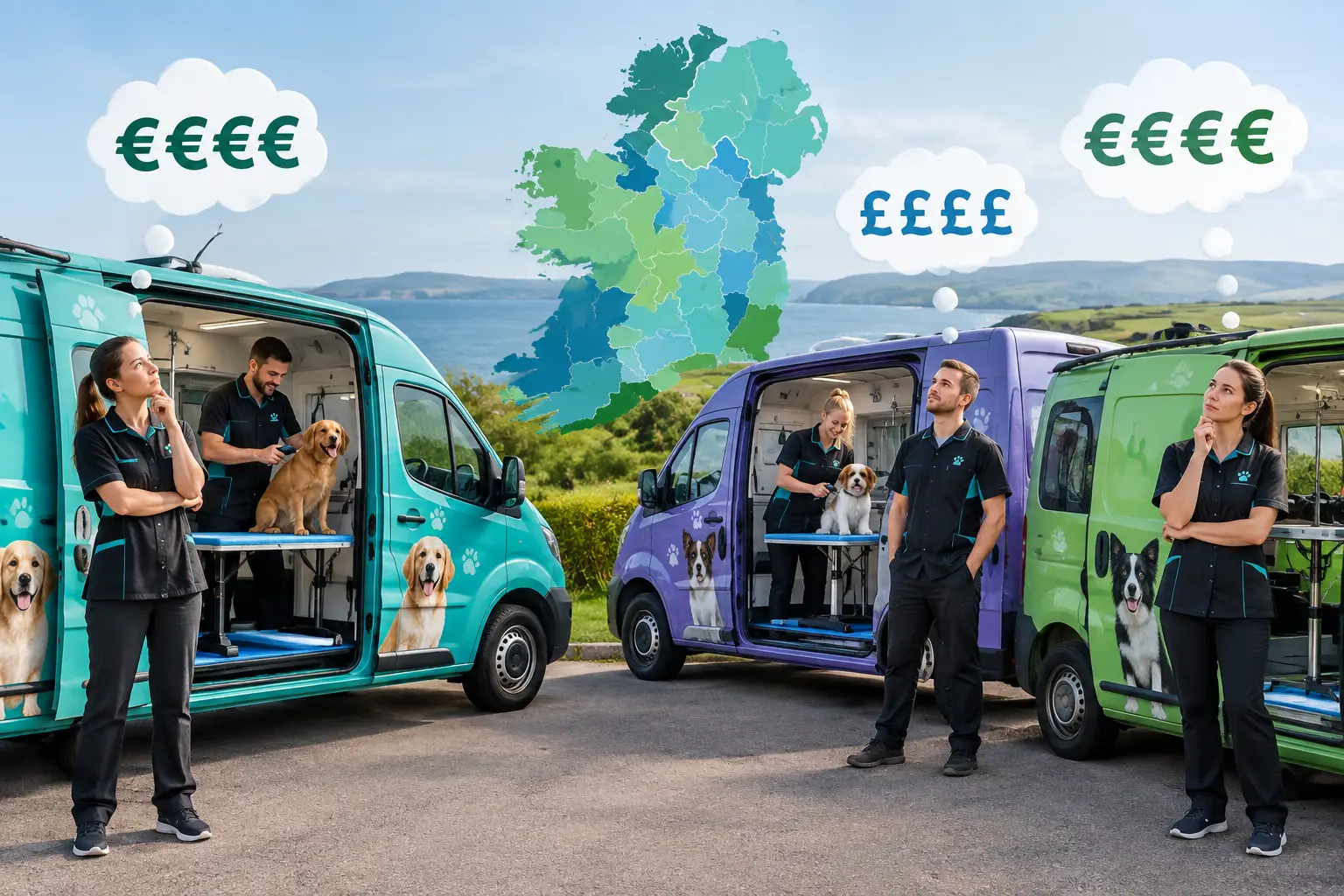
For example, if your combined business costs and desired earnings require the van to generate €1153 per week,and you can reasonably sell 30 grooming hours, your average appointment income needs to be at least €41 an hour, that equates for Northern Ireland to the following £1,050 per week, and you can reasonably sell 30 grooming hours, your average appointment income needs to be at least £35 an hour. That is a starting point, not the final price. A dog that takes two hours, uses extra products and needs a longer journey should not be priced at the same level as a straightforward 45-minute wash and dry. ( Above are examples, you can earn considerably more with the right system in place)
Build a menu that customers can understand
Customers want clarity, but they also understand that dogs vary enormously. A fixed price for every "full groom" sounds simple until a compact, regularly maintained terrier is charged the same as a heavily coated, overdue large breed.
Use starting prices by size and coat type, then make it clear that the final cost depends on the dog's condition, behaviour, coat length and time required. This protects your margin while giving customers a fair expectation before they book.
A practical mobile grooming menu might cover short-haired small dogs, small clipped breeds, medium and large dogs, hand-stripping where offered, bath and dry services, puppy introductions, nail clipping and hygiene-only appointments. You do not need dozens of confusing categories. You do need enough detail to prevent a customer selecting a low-priced service that bears no relation to the dog in front of you.
When quoting, ask for the breed, age, approximate weight, coat condition, grooming history and clear photographs. Ask whether the dog is matted, nervous, elderly, reactive or likely to need two handlers. Those questions are professional, not awkward. They allow you to book enough time and give an accurate estimate.
Put a value on travel and territory
Travel is one of the biggest differences between a mobile business and a high-street salon. It is easy to underestimate because a ten-minute drive may not feel expensive. Yet across a week, scattered appointments can remove hours from your earning capacity and add significantly to fuel and vehicle wear.
The strongest approach is usually to organise your diary by area. Group customers within the same locality on the same day, reduce dead mileage and keep the van earning. A well-managed territory lets you offer a convenient service without letting travel swallow your profits.
You can build local travel into your standard prices and add a clear travel supplement for appointments outside your normal area. Alternatively, set a minimum booking value for longer journeys. The right choice depends on the density of customers in your territory and how far you are prepared to travel.
Do not quietly absorb a 30-minute detour for a low-value nail appointment. Combine it with nearby bookings, offer the customer the next area day, or charge a visit fee that makes the journey worthwhile. Boundaries are not bad customer service. They are how a reliable business stays available for the customers it serves best.
Charge properly for difficult coat work
Matted coats, heavy shedding, flea treatment cleaning, de-matting, coat rescue work and behavioural challenges can turn a routine booking into an extended appointment. If you do not have a policy for these situations, they will damage both your diary and your confidence.
State that additional time and coat work may carry an extra charge, subject to assessment. Then discuss it with the owner before proceeding wherever possible. Be direct and kind: explain what you have found, what is realistic for the dog's welfare, how long it is likely to take and what the added cost will be.
There is a welfare judgement here too. Severe matting is not simply a cosmetic issue, and prolonged brushing can be painful. In some cases, clipping the coat short is the kindest option. Price this work fairly, but never allow pressure to keep a customer happy to push you into an unsafe or unreasonable groom.
The same principle applies to dogs that require exceptional handling time. Some anxious dogs benefit from shorter, quieter appointments and regular visits. That can be a worthwhile specialist service, provided the price reflects the time and patience required.
Do not compete with the lowest price
New groomers often believe low prices are the fastest way to fill the diary. They can be, briefly. But bargain pricing attracts customers who shop only on price, makes later increases harder, and leaves little room for professional-grade products, maintenance or training.
Instead, compare your prices with nearby groomers to understand the market, then assess what is genuinely included in their service. A mobile groomer provides a different proposition from a salon. Home collection may be unnecessary. Parking, transport stress and waiting time are removed. Many owners will happily pay for that ease, particularly for older dogs, busy households and dogs that find travel difficult.
Price confidently, then make the service match the price. Turn up when promised, communicate clearly, keep the van immaculate, handle dogs with care, explain coat advice honestly and make rebooking simple. A premium is earned through consistency, not just stated on a price list.
Review prices before they become a problem
Your first price list should not be treated as permanent. Fuel, insurance, supplies and vehicle costs change. Your grooming speed and expertise will improve. Demand may grow in certain areas, while a particular type of appointment may consistently overrun.
Review figures every quarter. Look at the actual time each category takes, the distance travelled, average spend per customer, repeat booking rate and the appointments that leave you feeling rushed or underpaid. If a service repeatedly fails to meet your hourly target, adjust the price, tighten the booking criteria or stop offering it.
When an increase is needed, give regular customers reasonable notice and explain it simply. You do not need to apologise for running a sustainable business. A modest, planned increase is far easier to manage than a sudden jump after months of working below cost.
Let your pricing support the business you want
The right price is not the number that gets every enquiry to say yes. It is the number that allows you to give each dog proper care, maintain a dependable van, pay yourself fairly and build a business you are proud to own.
For new owners, that is where a proven framework makes a real difference. Dial a Dog Wash Ireland trains franchisees not only in practical grooming, but in the commercial discipline needed to turn appointments into a viable business. Set your standards high early, know your numbers and let every booking move you towards the freedom you started out for.