

Dog Grooming Training for Beginners Made Practical
20 Jul 2026
A dog that arrives with tangled or matted fur, long nails and a nervous temperament does not need someone who simply loves animals. It needs a calm, capable groomer who can assess the coat, handle it safely and make sensible decisions under pressure. That is what dog grooming training for beginners should prepare you for - not just a smart-looking trim, but the confidence to deliver a professional service that owners will trust and pay for.
For anyone considering a change of career, grooming offers something unusually tangible. You can develop a hands-on skill, work directly with dogs, build regular clients and create a business that fits around your territory and ambitions. The starting point is not previous salon experience. It is practical training, a willingness to learn and a clear plan for turning that training into income.
What beginners really need to learn
A good groom is the result of a process, not one clever clip. Before scissors or clippers come near a dog, a groomer needs to read its condition. Is the coat matted? Are there sore areas, lumps, parasites, skin irritation or signs that the dog is uncomfortable? Is the dog relaxed, excitable, elderly or likely to resist handling?
Beginners need to learn how to carry out that assessment without pretending to be a vet. You are there to identify concerns, protect the dog and communicate honestly with the owner. If a condition needs veterinary advice, the right decision is to pause and refer it. That judgement protects the animal, your reputation and your business.
Practical training should then cover safe bathing, drying, brushing, de-shedding, nail care, ear cleaning and hygiene. It should also teach handling techniques that reduce stress for both you and the dog. A confident groomer does not force a frightened dog through an appointment. They work patiently, use the right restraint and adjust the service where necessary.
Breed styles matter, but they are only one part of the job. Many customers want a tidy, manageable pet trim rather than a show-standard finish. You still need to understand coat types, clipping lengths, scissoring, finishing and how different coats react to equipment. The aim is to produce a comfortable, clean dog and a result that matches what the owner has agreed to.
Dog grooming training for beginners should be hands-on
Videos and written guides can introduce the language of grooming, but they cannot tell you how a moving dog feels on the table or how to hold a clipper safely around delicate areas. This is a physical profession. You learn by doing, with experienced guidance close by.
One-to-one practical training gives a beginner the best chance to make mistakes safely and correct them quickly. You can be shown how to position a dog, brush out a difficult coat, change blades, dry efficiently and create a balanced outline. More importantly, you can ask the questions that arise in real appointments rather than trying to guess your way through them alone.
Look for training that uses a range of dogs. Working only with a quiet, well-maintained pet will not fully prepare you for an anxious rescue dog, a large double-coated breed, a curly coat with hidden matting or an older dog that cannot stand for long. You do not need to become an expert in every breed overnight. You do need a solid method for assessing each dog and adapting safely.
Fast-track training can be a powerful route into the industry, provided it is intensive, practical and supported afterwards. The trade-off is simple: a short course can give you momentum, but your skill develops through repetition. The strongest route combines focused initial instruction with mentoring, refresher guidance and the chance to keep learning as your customer base grows.
The equipment is part of the skill
Buying equipment without knowing how to use it is an expensive way to begin. Clippers, blades, scissors, dryers, tables, bathing systems and safety restraints all have a purpose. The wrong choice can slow you down, produce poor results or make an appointment less comfortable for the dog.
You will need to understand four areas from the outset:
- Clipper and blade selection for different coat lengths and finishes.
- Scissors, combs and brushes suited to detangling, shaping and de-shedding.
- Drying equipment that removes moisture thoroughly without distressing the dog.
- Cleaning and maintenance routines that keep tools safe, sharp and reliable.
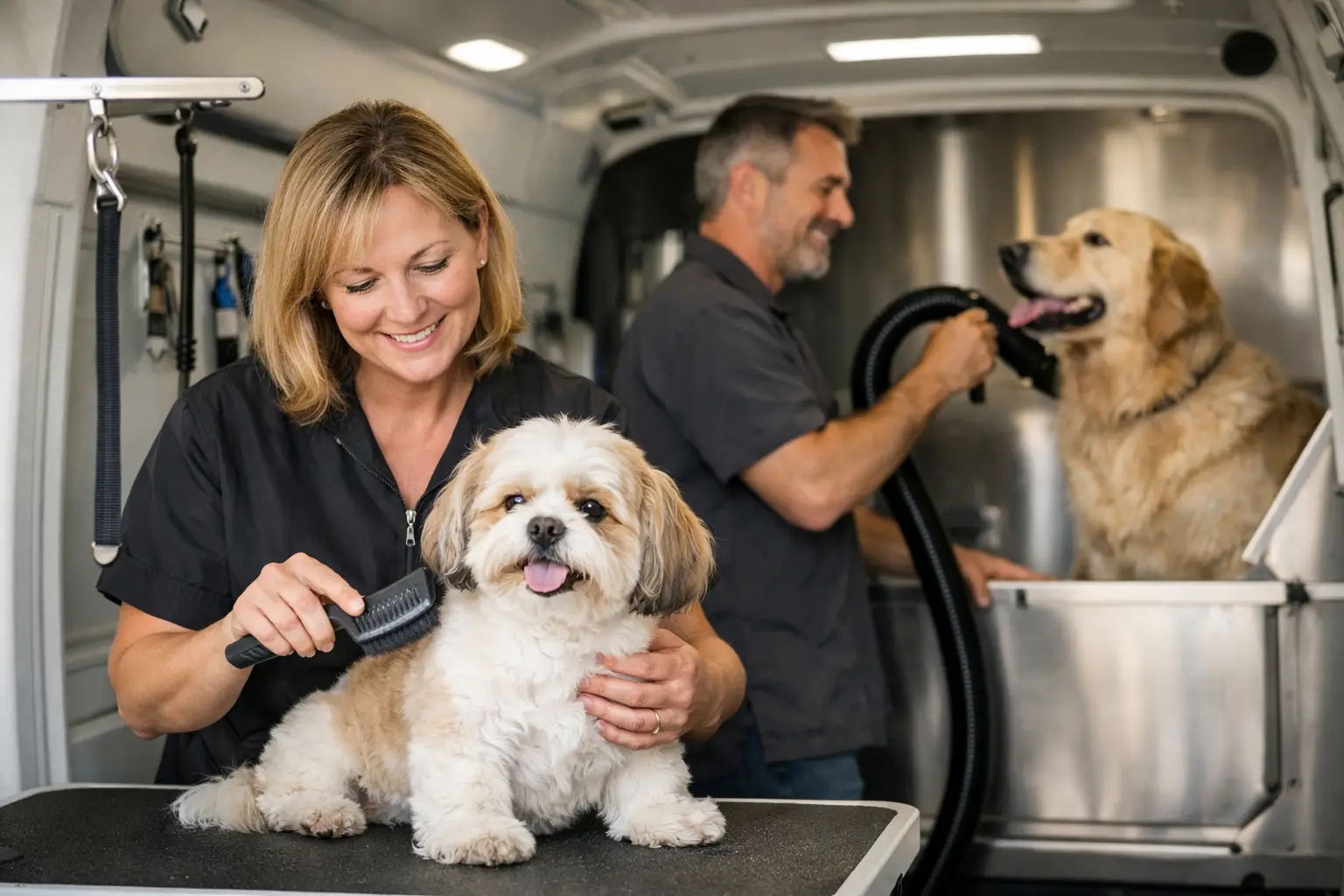
A professional set-up is not about buying the flashiest kit. It is about working efficiently and safely every day. This is particularly relevant in mobile grooming, where every item needs a place, water and power must be managed carefully, and the workspace has to stay clean between appointments.
Learn the customer side as well as the grooming
Many capable groomers struggle because nobody taught them how to run the business around the grooming table. If self-employment is your goal, business training is not an optional extra.
You need to know how to price appointments, account for coat condition and time, manage cancellations, take bookings, keep customer records and explain your services clearly. Underpricing is a common beginner mistake. A matted coat, a large dog or a nervous first-time customer may require considerably more time than a routine bath and tidy. Your prices must reflect the work involved if the business is going to support you.
Communication builds repeat custom. Be clear before the appointment about the requested style, the dog’s condition and any additional charges that may apply. Be kind but firm if a short clip is the most humane option for a severely matted dog. Afterwards, give simple coat-care advice that helps the owner maintain the result. Clients value honesty, consistency and the feeling that their dog has been treated with care.
Marketing matters too. A new groomer needs a recognisable local presence, reliable ways to attract enquiries and a process for turning first appointments into regular bookings. This is where starting independently can feel daunting. You are trying to learn a skilled service while also creating a brand, buying equipment and finding customers from scratch.
Why a mobile franchise route can reduce the risk
A mobile grooming business removes the cost and commitment of taking on a salon premises. You bring the service to the customer, which is convenient for busy owners, people with limited transport and dogs that find travelling stressful. It can also allow you to build a loyal client base within a defined local area.
However, a van alone does not create a business. You still need training, compliant working practices, equipment knowledge, customer systems and support when an unfamiliar situation arises. A proven franchise model can bring these pieces together, rather than leaving a beginner to assemble them through trial and error.
Dial a Dog Wash Ireland is built around that practical route: intensive grooming instruction, a fully equipped mobile set-up, marketing guidance and ongoing operational support. For a career changer who wants to start earning from a real service rather than spend months or years planning a business on paper, that structure can make the first step feel far more achievable.
It is not a shortcut around effort. You will still need to build relationships, work hard, keep improving and take responsibility for your territory. What a strong support system does is remove many of the avoidable obstacles, so your energy can go into serving customers and becoming better at the craft.
Is grooming the right move for you?
Dog grooming suits people who enjoy practical work and do not mind being on their feet. It calls for patience, a steady manner and the ability to stay focused when a dog is wet, wriggly or having a difficult day. It also rewards people who like routine, visible results and the independence of building something of their own.
Age or a lack of formal grooming experience should not rule you out. Many successful business owners begin after redundancy, a long career in another sector or years of feeling stuck in work that no longer fits. The question is whether you are ready to learn a trade properly and apply it with the discipline of a business owner.
Start by looking for training that puts real dogs, real equipment and real customer situations at the centre. Choose support that continues after the initial learning period, because confidence is built appointment by appointment. With the right foundation, your first groom does not have to be the moment you hope it works - it can be the beginning of a business you know how to grow.