

How Grooming Vans Operate in Real Life
08 Jul 2026
A mobile grooming van pulls up outside a customer’s home, the dog is collected at the door, and within a short time that dog is washed, dried, clipped and returned looking spot on. From the customer’s side, it feels simple. But if you are looking at self-employment, understanding how grooming vans operate matters because the real value is in the system behind that convenience.
For anyone thinking about starting a dog grooming business, a van is not just transport. It is your workspace, your branding, your equipment room and, in many cases, the reason you can start earning without taking on the cost of a salon. That is a serious advantage if you want a business that is practical, proven and quicker to launch.
How grooming vans operate day to day
At the heart of the model is a fully fitted van designed to carry out professional grooming appointments on the move. Instead of renting a premises, fitting out a shop and waiting for footfall, the groomer travels directly to the customer. The dog stays close to home, the owner avoids the usual drop-off and pick-up routine, and the business owner can work through booked appointments in a defined local area.
The day normally starts with route planning and equipment checks. The van is stocked with shampoos, towels, grooming tools and cleaning products. Water levels, power systems and heating are checked before the first appointment. Then the groomer works through a scheduled run of customers, usually clustered within a territory to reduce wasted driving time and keep the day efficient.
That efficiency is a big part of why the model works. A fixed salon can lose time through no-shows, gaps between appointments and overheads that continue whether the diary is full or not. A mobile van still needs tight scheduling, but it gives the owner much more control over travel, territory and working hours.
What is inside a grooming van?
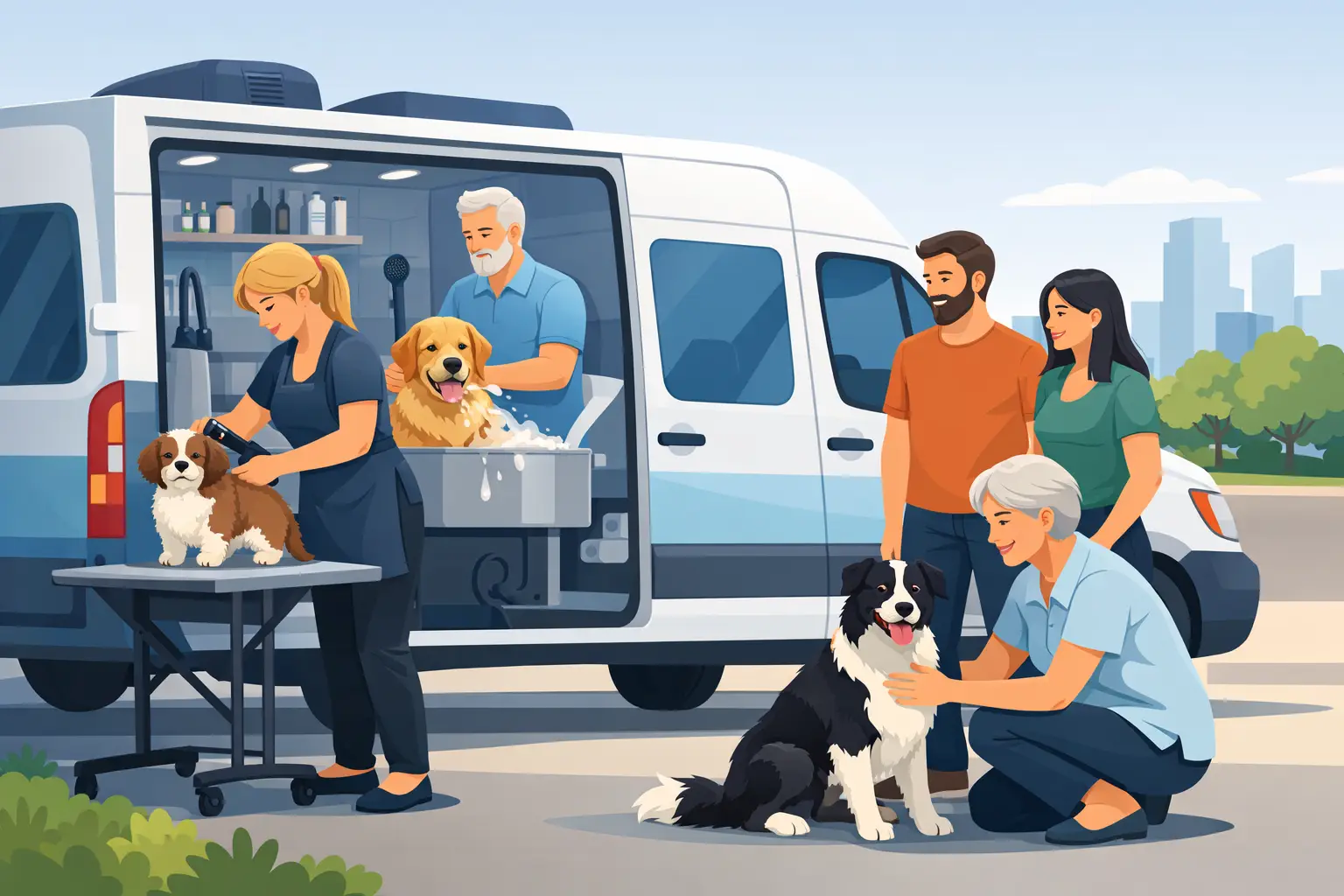
People often assume a grooming van is just a vehicle with a table in the back. In reality, a proper setup is a compact grooming unit built to support safe, professional work. Most converted vans include a hydrobath or bathing area, a grooming table, dryers, clipping and grooming equipment, water storage, electrical systems, lighting, heating and storage for products and consumables.
Good layout matters more than most people realise. Space is limited, so everything has to be placed for speed, safety and comfort. The groomer needs enough room to bathe and dry the dog without awkward movement, and the dog needs a calm, controlled environment. When a van is fitted well, the workflow feels natural. Wash, dry, groom, clean down, then move to the next appointment.
The power setup can vary depending on the conversion. Some vans use generators, others rely on battery and inverter systems, and some use a combination, some models plug into the customers home electric supply. Water tanks carry clean water in and waste water is taken out. But going to the customers home - this is the main reason mobile grooming feels premium to the customer.
The appointment process from booking to handover
The customer journey is simple by design. A customer books an appointment, the van arrives at the agreed time, the dog is groomed on site, and the dog is returned. That convenience is exactly what drives repeat custom.
Behind that straightforward process is a routine that needs to be consistent. The groomer usually confirms the booking, reviews the dog’s coat condition, temperament and grooming requirements, and then carries out the work according to breed type, owner preference and welfare needs. Some dogs need a basic bath and tidy. Others need a full groom including clipping, de-shedding, nail trimming and ear cleaning.
This is where training becomes critical. It is one thing to have a fitted van. It is another to assess a nervous dog properly, manage time well, carry out the groom safely and keep the customer confident. Anyone serious about this trade needs experienced, skilled, practical, hands-on instruction, not guesswork.
Why customers like the mobile model
When you understand how grooming vans operate, you also understand why customers love them. The service comes to the door. There is less disruption to the owner’s day. Dogs often stay calmer because they are not being left in a busy salon for hours. For older customers, busy families and people with limited transport, the convenience is hard to beat.
There is also a trust factor. A recognised and branded van parked outside the home looks professional and visible. The owner can speak directly to the groomer before and after the appointment. That one-to-one relationship helps build loyalty, and loyalty is what turns a mobile round into a dependable business.
Of course, not every dog is identical and not every road or estate is equally straightforward. Parking, access and local traffic can affect the running order. Some dogs need longer than expected, especially if coat condition has been neglected. That is why strong scheduling and realistic appointment times matter. The business can be flexible, but it should never be chaotic.
How grooming vans operate as a business model
This is the part many career changers care about most. A grooming van is not only a service unit. It is a business model with lower premises costs and a clear route to revenue.
A salon brings visibility, but it also brings rent, rates, utility bills and the cost of fitting out a building. A mobile operation removes much of that. You still have fuel, maintenance, insurance, stock and training costs, but the overhead structure is usually far leaner. For many new business owners, that makes the leap into self-employment feel achievable rather than risky.
It also gives you control over your patch. If appointments are grouped in a defined territory, travel is manageable and marketing becomes more focused. You are not trying to reach everyone everywhere. You are building a strong local customer base that sees your van regularly and starts to recognise the brand.
That said, the model works best when it is supported by proven systems. A van on its own does not create bookings. You still need training, local marketing, customer handling, pricing discipline and ongoing support, this is not easy. This is where many independent start-ups struggle. They buy equipment before they understand operations.
The role of training, support and systems
If you have never groomed professionally before, the right question is not whether mobile grooming works. It clearly does. The real question is whether you can learn to run it properly and profitably.
That is why a supported franchise route appeals to so many people changing careers. Instead of starting from scratch, you get a van built for purpose, practicaland intensive dog grooming training to succeed quickly, marketing guidance and a framework that has already been tested. For someone leaving employment, facing redundancy or simply tired of working hard for someone else’s business, that support removes a huge amount of uncertainty.
A strong operator learns more than clipping techniques. They learn how grooming vans operate commercially - how to schedule a day, manage territory, turn enquiries into repeat customers, maintain standards, protect the dog’s welfare and keep the diary moving. Those are the skills that create income.
That is also why businesses such as Dial a Dog Wash Ireland attract people with no previous grooming background. The model is designed to help ordinary people become capable operators quickly, provided they are willing to follow a proven system and put the work in.
Is a grooming van right for everyone?
Not automatically. You need to be comfortable working independently, managing dogs one to one and keeping to a disciplined routine. There is physical work involved. You are lifting, cleaning, driving, grooming and dealing with customers every day. If you want a business that runs itself, this is not it.
But if you want a business with visible demand, practical service delivery and the chance to earn from day one, it is a very strong option. You are not waiting for customers to walk past a shop front. You are taking the service directly to them. That changes the economics and the pace of growth.
For many people, especially those who want control over their time and future, that is the real attraction. You can build a business in your local area, work with dogs every day, and do it through a model that is already proven and profitable in the market.
If you have been wondering how franchise grooming vans operate, the answer is simple. They operate through smart design, practical workflow, local demand and tested disciplined systems. Get those pieces right, and a van becomes far more than a vehicle. It becomes a serious route into business ownership for people ready to back themselves.